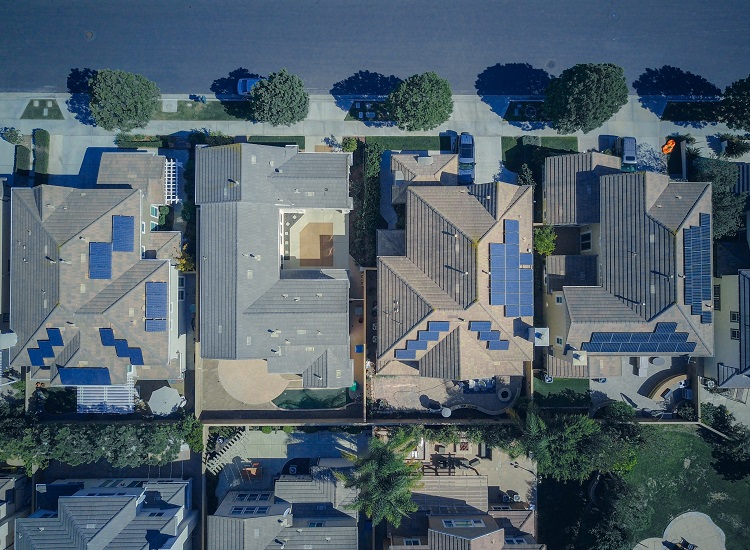
The passive solar design uses the way heat naturally functions (whereby heat moves from warmer materials to cooler ones until there is no temperature difference) in order to generate energy for a home. There are two types of radiation important to passive solar design: solar radiation and infrared radiation. When radiation strikes an object, it is absorbed, reflected, or transmitted, depending on certain properties of that object. Opaque objects absorb 40-95 percent of incoming solar radiation from the sun, depending on their color-darker colors typically absorb a greater percentage than lighter colors.
This is why solar panels, for instance, tend to be dark-colored. Bright-white materials or objects reflect 80-98 percent of incoming solar energy. Clear glass transmits 80-90 percent of solar radiation, absorbing or reflecting only 10-20 percent. After solar radiation is transmitted through the glass and absorbed by the home, it is radiated again from the interior surfaces as infrared radiation. In this way, glass traps solar heat entering the home.
Five Elements of Passive Solar Home Design
The following five elements constitute a complete passive solar home design. Each performs a separate function, but all five must work together for the design to be successful.
Collector
Usually, a window through which sunlight enters the building. Typically, the collector, or apertures, should face within 30 degrees of true south and should not be shaded by other buildings or trees from 9 a.m. to 3 p.m. each day during the heating season.
Absorber
The hard, darkened surface of the storage element. This surface, which could be a masonry wall, floor, panel, or water container, sits in the direct path of sunlight. Sunlight hits the surface and is absorbed as heat.
Thermal mass
The materials that retain or store the heat produced by sunlight. The difference between the absorber and thermal mass, although they often form the same wall or floor, is that the absorber is an exposed surface whereas thermal mass is the material below or behind that surface.
Distribution
The method by which solar heat circulates from the collection and storage points to different areas of the house. A strictly passive design will use the three natural heat transfer modes-conduction, convection, and radiation-exclusively. In some applications, however, fans, ducts, and blowers may help with the distribution of heat through the house.
Control
Roof overhangs can be used to shade the aperture area during the summer months. Other elements that control under and/or overheating include electronic sensing devices, such as a differential thermostat that signals a fan to turn on; operable vents and dampers that allow or restrict heat flow; low-emissivity blinds; and awnings.
Direct Gain
Direct gain is the simplest passive solar home design technique. Sunlight enters the house through the aperture (collector) – usually south-facing windows with a glazing material made of transparent or translucent glass. The sunlight then strikes masonry floors and/or walls, which absorb and store the solar heat. The surfaces of these masonry floors and walls are typically a dark color because dark colors usually absorb more heat than light colors. At night, as the room cools, the heat stored in the thermal mass convicts and radiates into the room.
Some builders and homeowners have used water-filled containers located inside the living space to absorb and store solar heat. Water stores twice as much heat as masonry materials per cubic foot of volume. Unlike masonry, water doesn’t support itself. Water thermal storage, therefore, requires carefully designed structural support. Also, water tanks require some minimal maintenance, including periodic (yearly) water treatment to prevent microbial growth. The amount of passive solar depends on the area of glazing and the amount of thermal mass. The glazing area determines how much solar heat can be collected.
And the amount of thermal mass determines how much of that heat can be stored. It is possible to undersize the thermal mass, which results in the house overheating. There is a diminishing return on oversizing thermal mass, but the excess mass will not hurt the performance. The ideal ratio of thermal mass to glazing varies by climate. Another important thing to remember is that the thermal mass must be insulated from the outside temperature. If the thermal mass is not insulated, the collected solar heat can drain away rapidly.
Loss of heat is especially likely when the thermal mass is directly connected to the ground or is in contact with outside air at a lower temperature than the desired temperature of the mass. Even if you simply have a conventional home with south-facing windows without thermal mass, you probably still have some passive solar heating potential (this is often called solar tempering). To use it to your best advantage, keep windows clean and install window treatments that enhance passive solar heating, reduce nighttime heat loss, and prevent summer overheating.